Carpet Area vs Built-Up Area vs Super Built-Up Area Explained
Learn the difference between carpet, built-up and super built-up area, how loading inflates the price per square foot, and how to compare two flats fairly.
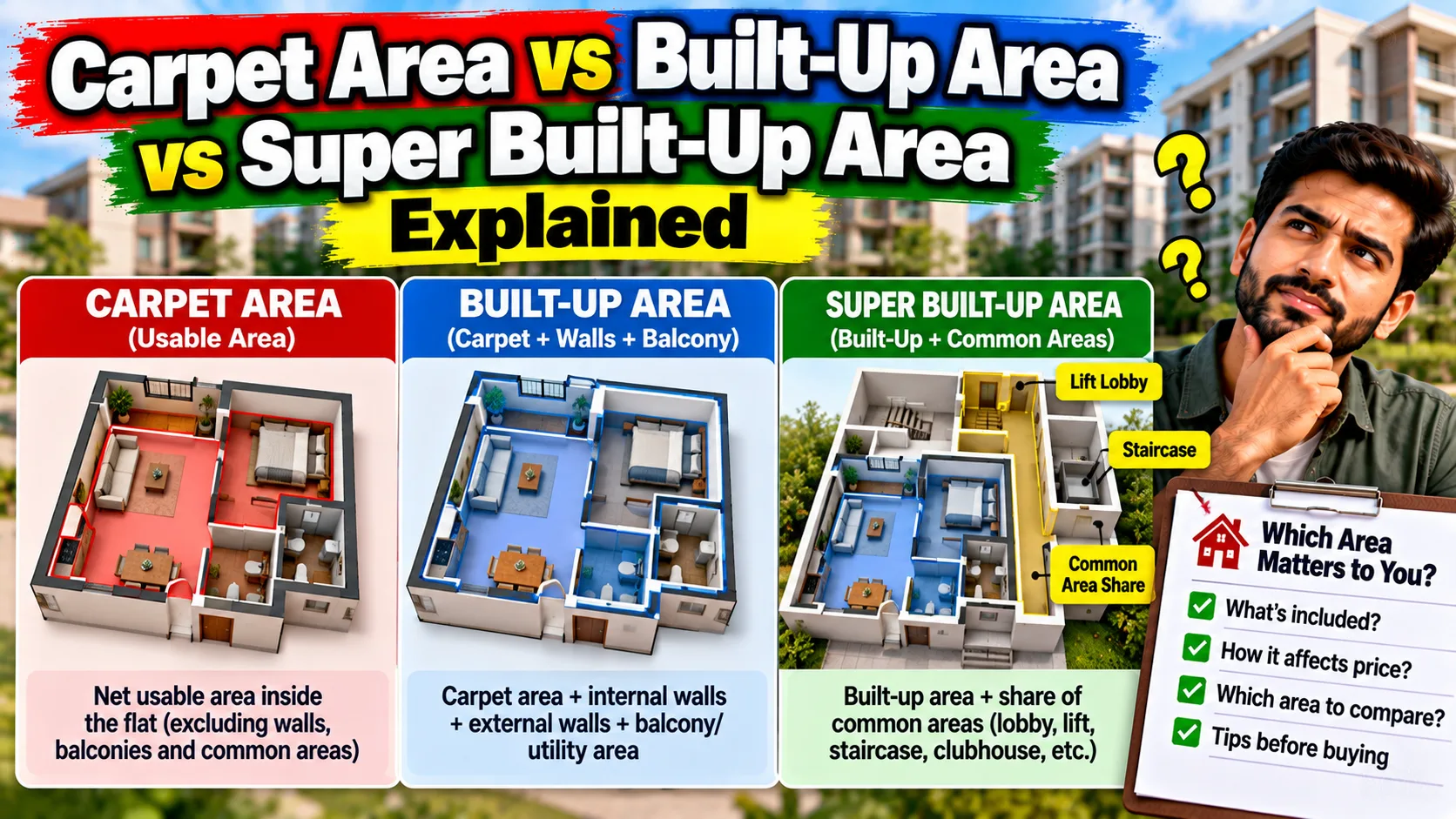
Two flats are advertised at the same size and the same rate per square foot, yet one costs lakhs more or gives you less living space. In most cases the reason is that they are measured in different ways. Before comparing prices, you need to know which "area" the seller is talking about.
In short: Carpet area is the space you can actually use. Built-up and super built-up areas add walls, balconies and shared spaces. Always convert the price to a per square foot of carpet area figure before comparing flats.
The three areas
Carpet area
Carpet area is the net usable floor area of the flat. Under the Real Estate (Regulation and Development) Act, 2016, it is the area enclosed by the walls of the apartment. It includes the thickness of the internal partition walls. It does not include:
- the thickness of the outer walls,
- service shafts,
- an exclusive balcony or veranda area, and
- an exclusive open terrace area.
In plain terms, it is the area on which you could lay a carpet from wall to wall, which is where the name comes from.
Built-up area
Built-up area is the carpet area plus the thickness of the outer walls and the exclusive balcony or terrace attached to the flat. It is larger than the carpet area because it counts the space taken up by walls and balconies.
Super built-up area
Super built-up area (also called saleable area in some cities) is the built-up area plus a share of common areas, such as the lobby, staircases, lifts, corridors, the clubhouse and sometimes the gym. The extra percentage added for these shared spaces is called loading.
Loading is not fixed by law. It varies by builder and city, and in some projects it is quite high. You never get to use the "loaded" space as part of your flat, yet you pay for it per square foot.
What this does to the price: a worked example
Imagine a flat with a carpet area of 800 sq ft.
| Measure | Typical calculation | Area |
|---|---|---|
| Carpet area | Measured inside the walls | 800 sq ft |
| Built-up area | Carpet + outer walls + balcony (assume +15%) | 920 sq ft |
| Super built-up area | Built-up + common areas (assume +30%) | 1,196 sq ft |
In this illustration the super built-up area is about 50% larger than the carpet area. The percentages here are only an example, since actual figures differ from project to project.
Now see what the price looks like if the builder quotes ₹6,000 per sq ft on super built-up area:
- Total price: 1,196 × ₹6,000 = ₹71.76 lakh
- Price per sq ft of carpet area: ₹71,76,000 ÷ 800 = ₹8,970
A buyer who thinks he is paying ₹6,000 per sq ft is in reality paying nearly ₹9,000 for each square foot he can use.
What counts and what does not: a quick reference
It helps to know where common parts of a flat fall, because this is where most arguments with builders start.
| Part of the flat | Carpet area | Built-up area | Super built-up area |
|---|---|---|---|
| Rooms, kitchen, bathrooms | Yes | Yes | Yes |
| Internal partition walls | Yes | Yes | Yes |
| Outer walls | No | Yes | Yes |
| Exclusive balcony or veranda | No (under RERA) | Yes | Yes |
| Exclusive open terrace | No (under RERA) | Often listed separately | Often listed separately |
| Lift, stairs, lobby, corridors | No | No | Yes (as a share) |
| Clubhouse, gym, garden | No | No | Sometimes (as a share) |
Some builders and older documents use these words loosely. Two projects can describe the same flat with different numbers, so always ask which items have been counted.
What RERA changed
Before RERA, builders could sell on super built-up area, and the carpet area was often not stated at all. Under RERA, the agreement for sale has to state the carpet area, and apartments are to be sold on that basis. The balcony and open areas can be stated separately.
If you buy in a RERA-registered project, check the carpet area on the project's registration page and compare it with your agreement. Our guide on how to check a RERA project shows the steps.
Remember, though, that real estate advertising and brochures still often use super built-up area. In resale flats and older buildings, the documents may mention only built-up area. Always ask for the carpet area in writing.
How to compare two flats fairly
- Ask for the carpet area of each flat in writing, and for the price per sq ft on that basis.
- Divide the total price by the carpet area. Include GST and any extra charges you will pay for parking and amenities to get the true cost.
- Ask for the loading percentage if the builder quotes super built-up area. Compare it with similar projects nearby.
- Check the floor plan for how much of the area is usable. Long corridors, odd corners and thick pillars reduce usable space.
- Measure the flat yourself during the site visit, or when you see the sample flat or the finished flat. A simple tape measure is enough for a rough check.
Checklist: questions to ask the seller
- What is the carpet area of this exact unit, in sq ft or sq m?
- Is the balcony included in that figure, or listed separately?
- What loading has been applied to arrive at the saleable area?
- On which area is the price per sq ft calculated?
- What do the RERA registration page and the agreement for sale say about carpet area?
Frequently asked questions
Is carpet area always smaller than the area in the brochure?
Usually yes, since brochures often quote the super built-up area. The carpet area can be 25–35% smaller or even more, depending on the project, but it varies a lot, so ask for the exact figure.
How is carpet area measured, in sq ft or sq m?
Both are used. RERA documents often use square metres. To convert, multiply square metres by 10.764 to get square feet.
Can a builder change the carpet area after I sign?
Under RERA, if the carpet area delivered is less than what is in the agreement, the buyer is entitled to a refund of the excess price paid, with interest, as per the rules of your state. If it is more, the promoter may ask for the extra price within the limits of the agreement. Read the area clause carefully before you sign.
Does the bank lend on carpet or super built-up area?
The loan depends on the agreement value and the bank's valuation of the property. Banks' valuers usually consider the carpet or built-up area of the actual flat, so a high loaded price may not be fully supported by the valuation, leaving you to pay the gap. See how banks decide your eligibility.
The percentages and prices in this guide are illustrations. Definitions can differ slightly by state rules, so confirm them with your state RERA rules and your lawyer.