What Is RERA and How to Check a Project Before You Book
What the RERA Act protects, which projects must register, and the exact steps to verify a builder and project on your state RERA website before booking.
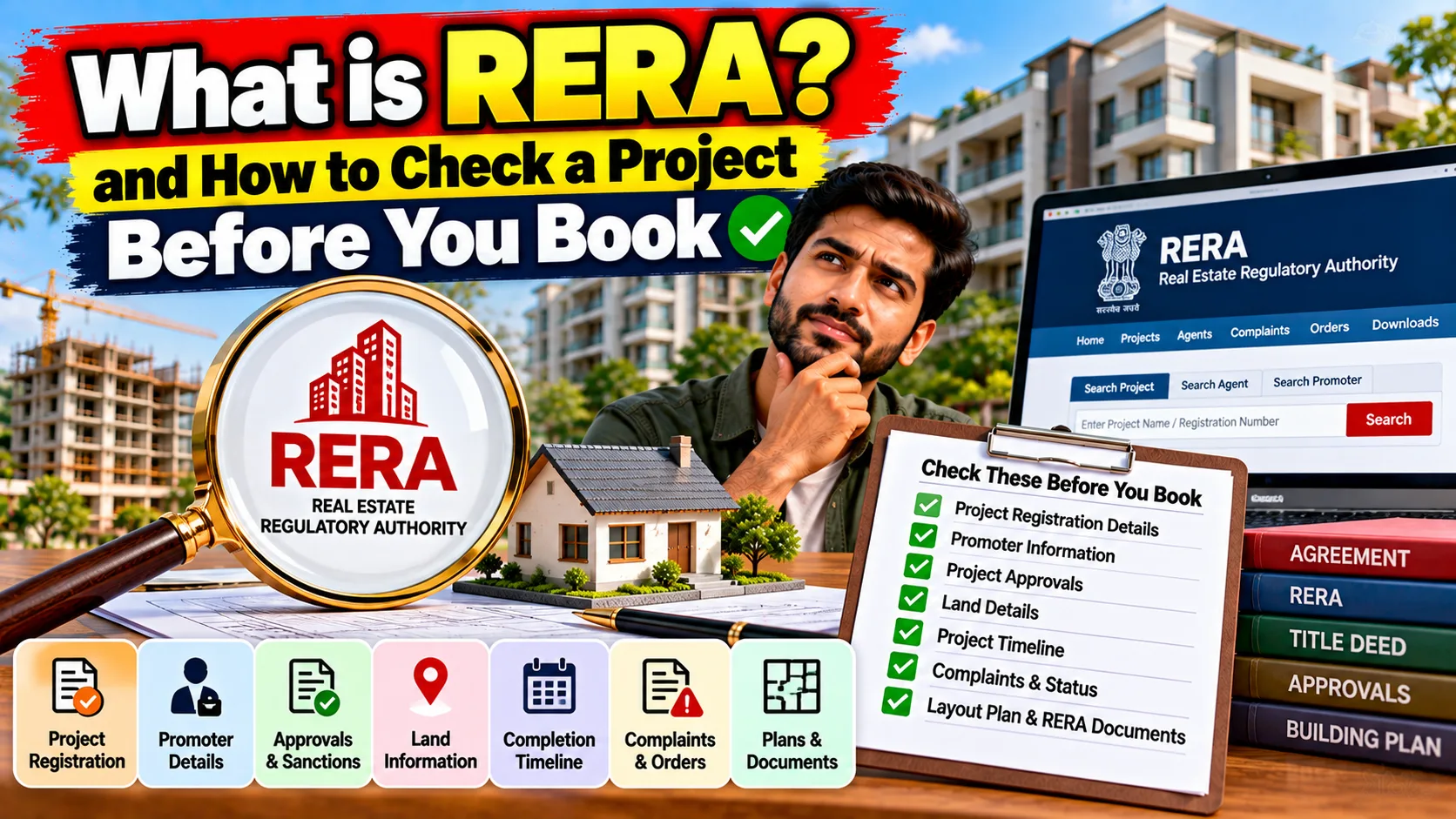
If you are thinking of booking a flat in a project that is not finished yet, one check should come before the brochure, the site visit and the discount: is the project registered with your state's RERA authority?
RERA is the Real Estate (Regulation and Development) Act, 2016. Parliament passed it because buyers had little protection against delays, changed plans and unclear areas. Each state has its own RERA authority and rules, but the main protections are the same across India.
In short: A registered project has a public page showing its approved plan, timeline, promoter details and complaints. If you cannot find the project on the RERA website, do not pay a booking amount.
Which projects must be registered
Under the Act, a real estate project must be registered with the state RERA authority before it is advertised or sold. In general, registration is required if:
- the land area is more than 500 square metres, or
- the project has more than eight apartments, counting all phases together.
Smaller projects can be exempt. Projects that already had a completion certificate when the Act came into force were also exempt. Projects still under construction at that time had to register. Your state's rules decide the exact details, so use the RERA website of the state where the project is located.
What RERA gives you as a buyer
Carpet-area pricing. Apartments must be sold on carpet area, which is the usable floor area inside the walls. Vague terms such as "super built-up area" cannot be the only basis of the price. Our guide on carpet area, built-up area and super built-up area shows how much the difference can cost you.
A separate bank account. The promoter must deposit a large share of the money collected from buyers, generally 70%, in a separate account. That money can be used only for the land and construction cost of that same project. This is meant to stop builders from using one project's money to fund another.
Public information. The registration page carries the approved layout, the sanctioned plan, the declared completion date, and details of the promoter and the contractor. Promoters also have to file regular progress updates.
Compensation for delay. If the promoter fails to hand over possession by the date in the agreement, a buyer who stays in the project is entitled to interest for every month of delay. Many state rules link the interest rate to a State Bank of India lending rate plus a margin, but the formula differs by state. A buyer who wants to leave can ask for a refund with interest.
Structural defect liability. If a structural defect or poor workmanship appears within five years of possession, the promoter must fix it at no extra cost within 30 days of being told.
Limits on changing the plan. Major additions or alterations to the sanctioned plan need the consent of at least two-thirds of the buyers. The promoter cannot change the plan or layout of your unit without your written consent.
A written, registered agreement first. A promoter cannot take more than 10% of the cost as an advance or application fee without first signing a written agreement for sale and registering it.
How to check a project on the RERA website
The steps below use Bihar RERA (rera.bihar.gov.in) as an example. Other states have a similar layout, though menu names differ.
- Ask the builder for the RERA registration number. It must appear on brochures and advertisements. A builder who cannot give it is a red flag.
- Open your state RERA website and go to the section for registered projects. On the Bihar site this is the Projects option on the home page.
- Search by project name, promoter name or registration number. You can usually narrow the results by district, project type and carpet area.
- Open the project page and confirm the promoter's name matches your booking form and agreement.
- Check the dates. Look at the registration validity and the declared completion date. If the registration has expired or has been extended more than once, ask why.
- Read the approved layout and plan. Compare the tower, floor and unit you are buying with what is on file.
- Check complaints and orders against the promoter and the project.
- Save the page. Download the details or take a screenshot with the date, in case the brochure and the registered details differ later.
Checking an agent or broker
Real estate agents who work on projects in the RERA area must also be registered. Ask for the agent's RERA number and look it up on the same website. Do not pay any agent directly in cash.
What to do if something goes wrong
If a registered promoter delays possession, changes the plan without consent or refuses to fix defects, you can file a complaint with the state RERA authority through its website. Most authorities charge a small complaint fee. For Bihar the fee has been listed as ₹1,000, but check the current figure on the website. Keep copies of your agreement, payment receipts, emails and any notices.
If you find a project that is being sold without registration, most RERA websites also have a link to report it.
Common mistakes buyers make
- Trusting the number without checking it. A registration number printed on a hoarding means nothing until you find it on the official site.
- Signing an agreement that differs from the registered plan or carpet area.
- Paying a "booking amount" before the agreement for sale is written and registered.
- Paying in cash or into a personal account instead of the project's designated bank account.
- Assuming RERA covers everything. RERA helps when a project is registered and the promoter breaks the rules, but it does not remove the need to read the agreement or check the title documents. See our checklist of documents to verify before buying a property.
Frequently asked questions
Does RERA apply to ready-to-move flats?
Not usually. RERA is aimed at projects that are under development. A project that already had its completion or occupancy certificate when the Act came into force was exempt, and finished projects are generally not registered. Resale of a finished flat is checked through title documents and approvals, not RERA.
Can a builder advertise before registering?
No. Promoters must register before they advertise, market, book or sell units in a project that needs registration.
What is the difference between carpet area and super built-up area?
Carpet area is the floor area you can actually use inside the walls. Super built-up area adds the wall thickness, balconies and a share of common areas such as the lobby and lifts. RERA requires sales to be based on carpet area.
Is a RERA-registered project completely safe?
Registration improves your position, but it is not a guarantee. A registered promoter can still delay a project, so read the agreement closely, check the track record of earlier projects and ask a lawyer to review the papers before you sign.
Rules, thresholds and fees differ by state and can change. Check the website of your state RERA authority for the current position. This guide is general information, not legal advice.