Home Loan Eligibility: How Banks Decide How Much to Lend You
How banks calculate your home loan eligibility, from income and existing EMIs to credit score and loan-to-value limits, with a worked example you can repeat yourself.

"Will I get a home loan, and for how much?" is the first question most buyers ask. The honest answer is that banks do not use a secret formula. They look at four things: how much you earn, how much you already owe, how reliably you have repaid in the past, and how much the property is worth.
Once you know these four, you can estimate your own eligibility before you visit a bank, and you can improve it before you apply.
In short: Lenders cap your total EMIs at roughly 40–50% of your monthly income, prefer a credit score of about 750 or higher, and, as per RBI limits, lend only up to a fixed share of the property's value. You pay the rest as a down payment.
1. Your income and the EMI limit
Banks start with your net monthly income: salary after tax and deductions, or for self-employed people, income worked out from your tax returns and bank statements, usually over two to three years.
They then apply a limit on how much of that income can go to EMIs. This is often called the FOIR (fixed obligations to income ratio). Lenders commonly allow about 40–50% of net income, and sometimes less for lower incomes. The exact figure differs from bank to bank.
Example. Your net monthly income is ₹1,00,000, and the bank's limit is 50%.
- Maximum total EMIs allowed: ₹50,000 a month.
- Existing EMIs (for example a car loan of ₹10,000): ₹10,000.
- Room for a new home loan EMI: ₹40,000 a month.
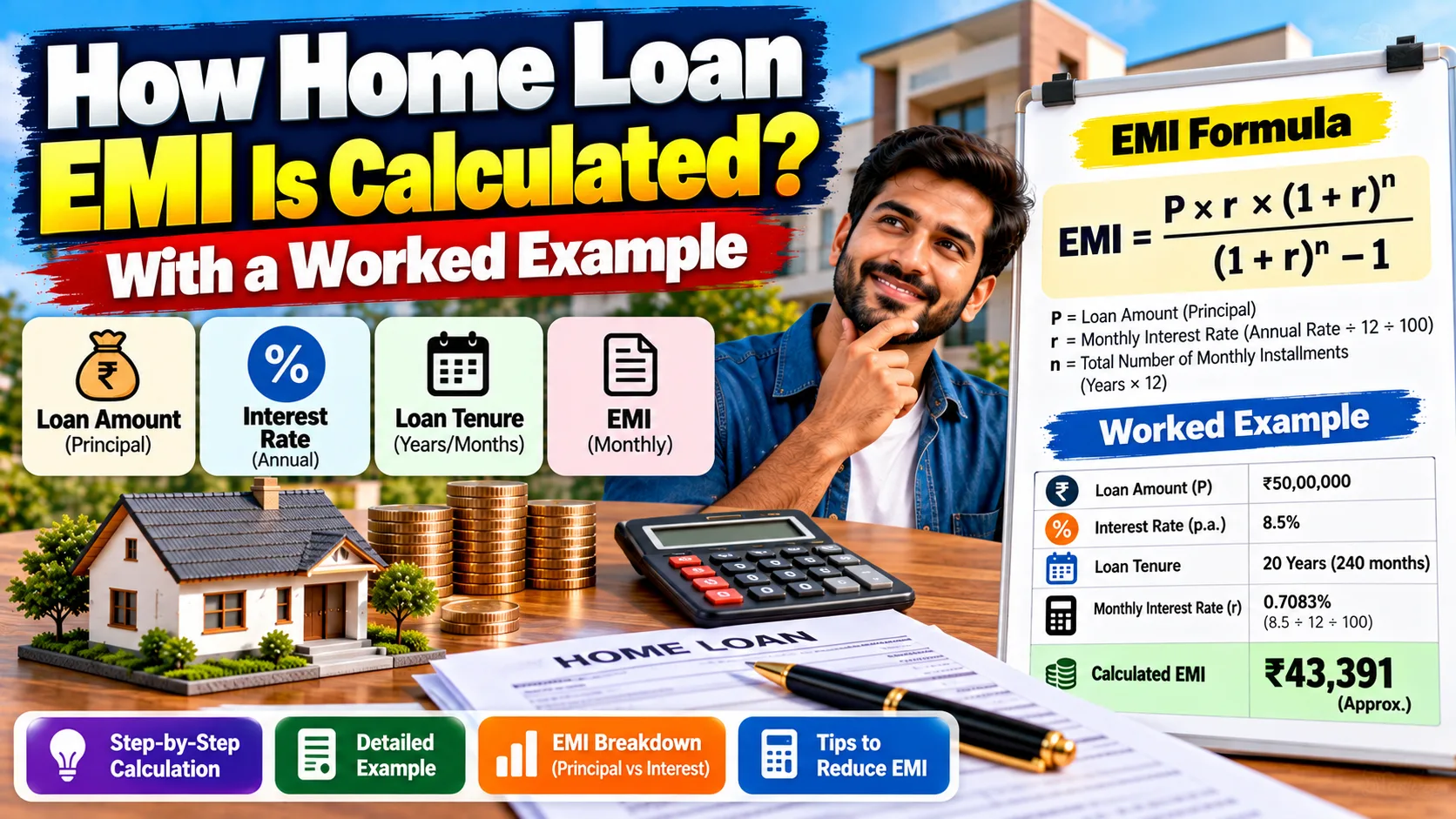
At 8.5% interest for 20 years, every ₹1 lakh of loan has an EMI of about ₹868. So ₹40,000 a month supports a loan of roughly ₹46 lakh. With no existing EMIs, the same income would support about ₹57.6 lakh at a 50% limit, or about ₹46 lakh at a 40% limit.
This is why clearing a small loan or credit card balance before you apply can raise your eligibility more than you would expect. Our EMI guide shows how the monthly figure is calculated.
2. Your age, job and income stability
- Age and tenure. Lenders set a maximum age at the end of the loan, often 60 to 70 depending on the lender and whether you are salaried or self-employed. A younger borrower can choose a longer tenure and therefore a lower EMI.
- Job stability. Salaried applicants usually need a minimum period of employment and a confirmed job. Self-employed applicants usually need two or three years of filed returns and a stable business.
- Other income. Rent from another property, a spouse's income as a co-applicant, or regular bonuses can be counted if you can prove them.
Adding a co-applicant. A spouse or parent who earns can raise the eligible loan, because the bank counts both incomes. Both become fully responsible for the loan.
3. Your credit score and history
In India, credit bureaus such as CIBIL, Experian, Equifax and CRIF High Mark give you a score between 300 and 900. Banks look at it to judge how reliably you repay.
- A score of about 750 or above is generally seen as good and helps you get a better rate.
- A lower score does not always mean rejection, but can mean a higher rate, a smaller loan or extra conditions.
- Banks also read the report itself: missed payments, settled loans, high credit card usage and many recent applications all count.
You have the right to a free credit report from each credit bureau once a year. Check it before you apply, and correct any mistakes in it. Errors such as a loan shown as unpaid when you closed it are common and fixable.
What helps your score before you apply:
- Pay every EMI and credit card bill on time, every time.
- Keep credit card usage low compared with your limit.
- Avoid applying for several loans or cards within a short period.
- Do not close old accounts that have a good history just before applying.
4. The property and the loan-to-value limit
Banks do not lend the full price of the house. The Reserve Bank of India sets limits on the loan-to-value (LTV) ratio, which is the share of the property's value that can be financed:
| Loan amount | Maximum loan-to-value |
|---|---|
| Up to ₹30 lakh | 90% |
| ₹30 lakh to ₹75 lakh | 80% |
| Above ₹75 lakh | 75% |
The rest has to come from you as the down payment, also called the margin.
Examples:
- Property of ₹25 lakh: the bank can lend at most ₹22.5 lakh, so you need at least ₹2.5 lakh.
- Property of ₹60 lakh: the bank can lend at most ₹48 lakh, so you need at least ₹12 lakh.
- Property of ₹90 lakh: the bank can lend at most ₹67.5 lakh, so you need at least ₹22.5 lakh.
The LTV is calculated on the lower of the agreement value and the bank's valuation of the property, so if the valuer says the property is worth less than you are paying, you pay the difference. You also need to budget for stamp duty, registration, GST on under-construction flats and other charges, which are not covered by the loan. See our guide to the hidden costs of buying a flat.
The property itself must also pass the bank's legal and technical check. A property with unclear title, missing approvals or a disputed builder can be rejected even when your income is fine. Our checklist of documents to verify before buying covers what banks look at.
Documents banks usually ask for
Salaried: identity and address proof, PAN, recent salary slips, Form 16 or tax returns for two years, and six months of bank statements.
Self-employed: identity and address proof, PAN, income tax returns with computation for two to three years, business proof, and bank statements.
For the property: sale agreement or allotment letter, title documents, approved plan and, for projects, RERA registration details.
How to raise your eligibility
- Reduce existing EMIs or clear small loans first.
- Add an earning co-applicant.
- Choose a longer tenure, then prepay when you can.
- Improve your credit score and fix errors in your report.
- Increase your down payment, which reduces the loan you need.
- Compare lenders. Eligibility rules and rates differ, so a loan declined by one lender may be approved by another.
Frequently asked questions
What is a good credit score for a home loan?
Many lenders prefer 750 or above. Applicants with lower scores may still be approved at a higher interest rate or with a smaller loan.
Does applying to many banks reduce my score?
Each formal loan application creates a credit enquiry. Several enquiries in a short time can lower your score and look like desperation to lenders. Use eligibility calculators and pre-approval conversations first, and apply formally to one or two lenders.
Can I get a home loan if I am self-employed?
Yes. Lenders look at your tax returns and bank statements over a few years instead of salary slips. Filing returns on time and showing stable profits improves your chances.
Is pre-approval a guarantee?
No. A pre-approved loan is a preliminary offer based on your profile. The final sanction depends on verification of your documents and the property.
Ratios, rates and age limits vary by lender and change over time. The figures here are illustrations. Ask the lender for its current policy and read the sanction letter before you commit.