Hidden Costs of Buying a Flat in India: A Complete Checklist
The advertised price is only the start. Learn every extra cost when buying a flat in India, from GST and stamp duty to parking and deposits, with a worked example.
You have found a flat you like at ₹60 lakh. The builder says the price is "all inclusive", the bank approves a loan, and you start planning your down payment. A few weeks later you discover that the amount you need in your account is far larger than you thought.
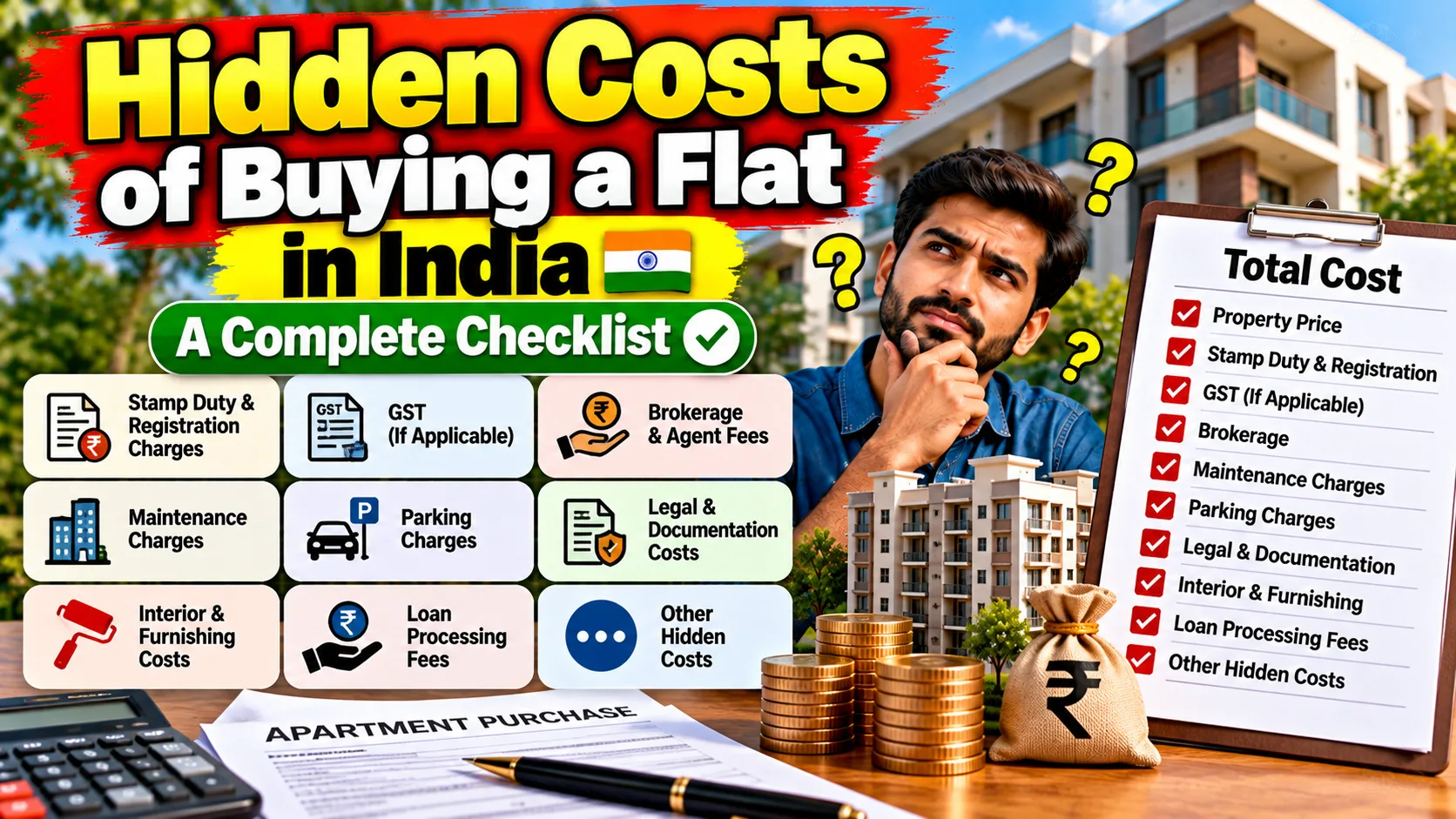
The agreed price is rarely the total price. Taxes, government charges, builder extras and loan costs all come on top. This guide lists each of them, so you can budget before you sign and not after.
In short: Expect to pay roughly 15–20% on top of the base price once GST, stamp duty, registration, parking, deposits and loan charges are added. The exact amount depends on your state, the project and whether the flat is ready or under construction.
1. GST (only on some flats)
GST depends on the stage of the property at the time you pay.
- Under-construction flat (not affordable): 5% GST, with no input tax credit for the buyer.
- Under-construction affordable flat: 1% GST. Under the rules as we last checked, affordable means a price up to ₹45 lakh and a carpet area up to 60 sq m in metro cities or 90 sq m elsewhere.
- Ready-to-move flat with a completion or occupancy certificate: no GST on the sale.
This is one reason the completion certificate matters. A flat that is almost finished but has no certificate yet can still attract GST. Rates and thresholds are set by the GST Council and have changed before, so confirm the latest position on the government's GST website or with your CA before you pay.
2. Stamp duty and registration charges
These are state government charges paid when the sale is registered, and they are usually the largest single extra cost.
- Each state sets its own rates. They are usually a single-digit percentage of the property value, and the registration fee is charged separately.
- Many states charge less to women buyers or allow a concession when the property is registered in a woman's name. Rules differ.
- The duty is normally calculated on the higher of the agreement value and the government's minimum value for the area (called the circle rate, guidance value or ready reckoner rate, depending on the state).
- Rates change and sources online often disagree, so check the state registration department's website or ask the sub-registrar's office for the exact percentage for your case.
3. Builder charges that are not in the headline price
Read the cost sheet attached to the agreement. Common extra items are:
- Parking. Covered or reserved parking is often sold separately for a lakh or more in many cities.
- Preferential location charges (PLC) for a higher floor, a garden facing flat or a corner unit.
- Club membership and amenity charges.
- Development, infrastructure or electricity charges.
- Advance maintenance and a corpus or sinking fund, which you pay once at possession.
- Water, sewage and power connection and meter charges.
- Legal and documentation fees charged by the builder.
Under RERA, the cost of the unit and charges for common areas should be clearly stated in the agreement. If an item appears only on a separate letter, ask for it in writing before you pay.
4. Loan-related costs
If you take a home loan, add:
- Processing fee, which is often a percentage of the loan amount, plus GST on that fee.
- Legal and technical valuation charges.
- Bundled insurance, such as life or property insurance, which may be offered along with the loan. Ask whether it is optional.
- Pre-EMI interest during construction, which you pay in addition to any rent. Our EMI guide explains how it works.
Also remember that the bank does not finance the full price. The loan-to-value limits mean you must pay a down payment from your own money. See how banks decide your eligibility.
5. Brokerage and miscellaneous
- Brokerage, if you used an agent, is commonly paid as a percentage of the price or as a fixed amount. Agree on the amount in advance.
- TDS on property. For most purchases above ₹50 lakh, the buyer must deduct 1% tax at source from the payment and deposit it with the government. It is not an extra cost, since it is part of the price you pay the seller, but you must arrange the cash flow and file the form on time. Check the current procedure on the Income Tax Department website.
- Society transfer fee for resale flats in cooperative societies.
6. Moving in
Even after you get the keys, there are costs the agreement does not cover:
- Interiors, modular kitchen and wardrobes, which can easily reach several lakhs.
- Light fittings, fans, curtains and appliances.
- A home insurance policy.
- Moving charges and any pending utility deposits.
A worked example
Here is an illustration for a ₹60 lakh under-construction flat in a project where the builder charges the amounts shown. Stamp duty and registration are assumed at 6% and 1% only to show the calculation. Your state's rates will differ.
| Item | Amount |
|---|---|
| Base price | ₹60,00,000 |
| GST at 5% | ₹3,00,000 |
| Stamp duty (assumed 6%) | ₹3,60,000 |
| Registration (assumed 1%) | ₹60,000 |
| Covered parking | ₹2,00,000 |
| Club and development charges | ₹1,00,000 |
| Advance maintenance and corpus fund | ₹60,000 |
| Legal and loan charges | ₹50,000 |
| Total outlay | ₹71,30,000 |
The extras come to ₹11.3 lakh, about 19% above the base price. If you finance 80% of the base price (₹48 lakh), the loan does not cover taxes or these charges. In this example, you would need about ₹23.3 lakh in cash for the down payment and the extras, before interiors.
How to avoid surprises
- Ask for the full cost sheet in writing before paying any booking amount.
- Compare flats on total cost, not on rate per square foot. Our guide to carpet area and super built-up area shows why.
- Ask the builder which charges are one-time and which are recurring.
- Find your state's current stamp duty and registration rates on the official registration website.
- Keep a buffer of 3–5% of the price for things you did not expect.
- Confirm the project is registered with RERA, so that the charges and the price in the agreement are on record. See how to check a project.
Frequently asked questions
Is GST charged on a resale flat?
No. GST applies to the supply of under-construction properties by a builder. A resale flat is a transfer between individuals, and no GST applies. Stamp duty and registration still do.
Who pays the stamp duty, the buyer or the seller?
By usual practice the buyer pays stamp duty and registration charges, but the agreement can say otherwise. Make sure the agreement states who pays.
Can I get the builder to waive parking or club charges?
Sometimes, especially during sales offers, but only if you get it in writing. Verbal promises do not bind the builder.
Do I pay GST on the maintenance charges?
Maintenance and other service charges by a builder or a society may attract GST above certain limits. Ask the builder to show GST clearly on the cost sheet.
All figures are illustrations. Rates of GST, stamp duty and registration fees differ and change. Confirm them with the relevant authority before you pay. This guide is general information, not tax or legal advice.