How Home Loan EMI Is Calculated, With a Worked Example
The formula behind your home loan EMI, a full worked example with real numbers, and how rate and tenure change the interest you pay over the life of the loan.
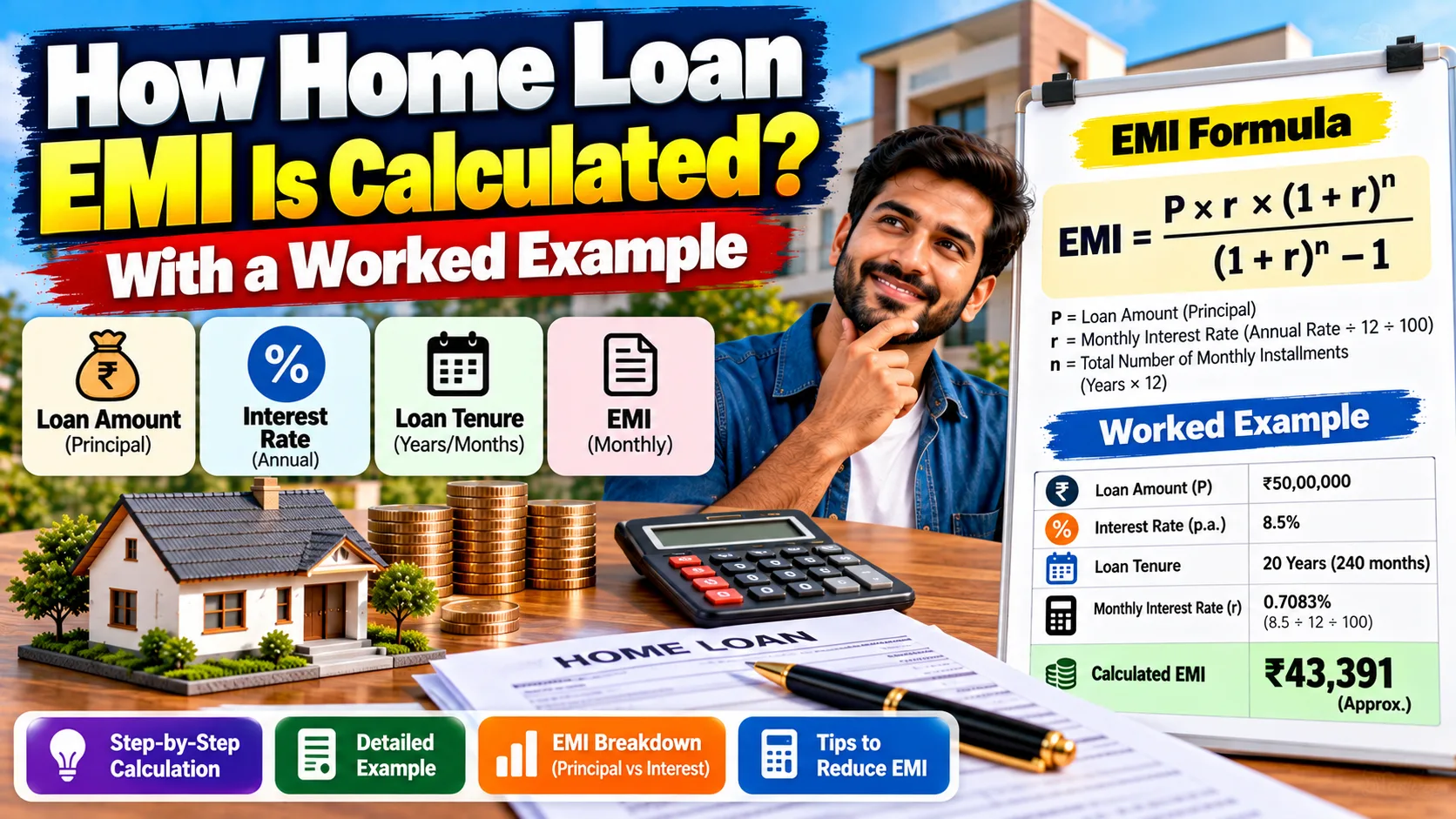
A home loan is usually the biggest financial commitment of a person's life, yet most borrowers only look at one number: the monthly EMI. If you understand how that number is built, you can compare bank offers properly, decide how long a loan to take and see why a small prepayment early on saves so much.
In short: Your EMI depends on three things: the loan amount, the interest rate and the tenure. In the early years most of each EMI is interest, so a shorter tenure or an early part-payment cuts the total cost far more than it seems.
The EMI formula
Most home loans in India are on a reducing balance. Interest is charged each month on the amount you still owe, not on the original loan. The EMI that keeps the monthly payment constant is:
EMI = P × r × (1 + r)ⁿ ÷ ((1 + r)ⁿ − 1)
- P is the loan amount (principal).
- r is the monthly interest rate. Divide the yearly rate by 12, then by 100. At 8.5% a year, r = 8.5 ÷ 12 ÷ 100 = 0.0070833.
- n is the number of monthly instalments. A 20-year loan has n = 240.
You do not need to do this by hand, because every bank has a calculator. But knowing the formula tells you what you can change: a lower rate, a longer tenure or a smaller loan all reduce the EMI, and they do it in different ways.
A worked example
Take a loan of ₹50,00,000 at 8.5% a year.
| Tenure | Monthly EMI | Total repaid | Total interest |
|---|---|---|---|
| 20 years | ₹43,391 | ₹1,04,13,879 | ₹54,13,879 |
| 15 years | ₹49,237 | ₹88,62,656 | ₹38,62,656 |
Choosing 15 years instead of 20 raises the EMI by about ₹5,846 a month but cuts the total interest by roughly ₹15.5 lakh. On a 20-year loan, you repay more in interest than you borrowed.
Where your first EMIs actually go
Interest is charged on the outstanding balance, and the balance is largest at the start. That is why the first years feel like you are barely reducing the loan.
For the ₹50 lakh, 20-year loan above:
- In the first month, interest is ₹50,00,000 × 0.0070833 = ₹35,417, out of the ₹43,391 EMI. Only about ₹7,974 reduces the principal.
- In the whole first year you pay about ₹4.21 lakh as interest and repay only about ₹99,500 of principal.
- After five years of regular EMIs, you still owe about ₹44.06 lakh. You have paid roughly ₹26 lakh, of which about ₹20 lakh was interest.
- After ten years, the balance is about ₹35 lakh.
This slow start is why people who take a loan and then sell or switch in the first few years are surprised by how little principal they have cleared.
How the interest rate changes your EMI
Even a small change in the rate moves your EMI and the total cost. For the same ₹50 lakh and 20 years:
| Interest rate | Monthly EMI |
|---|---|
| 8.25% | ₹42,603 |
| 8.50% | ₹43,391 |
| 8.75% | ₹44,186 |
| 9.00% | ₹44,986 |
| 9.50% | ₹46,607 |
A rise of 0.5 percentage points adds about ₹1,600 a month. If your loan has a floating rate, it can move when benchmark rates change. We explain how that works in our guide to fixed and floating home loan rates.
What a part-prepayment does
Suppose you make a one-time prepayment of ₹1 lakh at the end of the first year on this loan, and keep paying the same EMI. The loan finishes about 11 months earlier and you save roughly ₹3.8 lakh in interest. Because the balance is high in the early years, each rupee you prepay then removes the interest it would have earned for many years.
You have two ways to use a prepayment:
- Keep the EMI the same and shorten the tenure. This saves the most interest.
- Keep the tenure and reduce the EMI. This eases your monthly budget but saves less.
If your budget can handle it, the first option is usually cheaper in the long run.
On charges: under the Reserve Bank of India's pre-payment directions, regulated lenders cannot charge pre-payment penalties on loans to individuals for non-business purposes sanctioned or renewed on or after 1 January 2026. Floating-rate home loans to individuals were already free of such charges earlier. Check your sanction letter, because older fixed-rate loans can have different terms.
Pre-EMI while the house is being built
For an under-construction flat, the bank usually releases the loan in stages as the builder completes the work. Until the full amount is paid out, you typically pay pre-EMI, which is only the interest on the amount released so far. Full EMIs start after the last payment goes out. Remember that you may be paying pre-EMI and rent at the same time, so include that in your budget.
How to compare two loan offers
- Compare the effective cost, not just the rate. Add the processing fee, legal and valuation charges and any insurance the bank bundles with the loan.
- Ask what the rate is linked to and how often it resets.
- Ask how the bank treats a rate change. Some lenders keep the EMI the same and lengthen the tenure. Others raise the EMI.
- Test different tenures. Choose the shortest one whose EMI fits comfortably in your budget.
- Read the sanction letter fully. The rate, fees and conditions in the letter are the ones that bind you, not the ones in an advertisement.
A safe limit for your EMI
Banks usually prefer that your total monthly loan repayments, including the new EMI, stay under about 40–50% of your take-home income. Your own safe limit may be lower. If you support dependants, have irregular income or expect other big expenses, keep a buffer for repairs, insurance and rate rises. Our guide to home loan eligibility explains how lenders calculate this.
Frequently asked questions
Is EMI calculated on reducing balance or flat rate?
Home loans are on a reducing balance. Interest is calculated on what you still owe. A flat-rate method, where interest is charged on the original amount for the full period, is used by some personal and vehicle loans and makes the real cost much higher.
Why does my EMI stay the same when the interest rate changes?
On many floating-rate loans, lenders leave the EMI unchanged when the rate moves and instead lengthen or shorten the tenure. This can quietly stretch your loan by years after repeated rate increases. Ask your lender for an updated amortisation schedule at least once a year.
Does paying EMI on a joint loan change anything?
Each co-borrower is responsible for the whole loan, not just a share. The EMI is the same, but co-borrowers can each claim eligible tax benefits on what they pay, which we cover in our guide to home loan tax benefits.
Should I take the longest tenure to keep EMI low?
A long tenure keeps the EMI low but costs much more in interest. A better approach is to take a tenure you can manage and then prepay whenever you have spare money. That gives you flexibility without locking in the highest cost.
The figures in this guide are illustrations based on a reducing-balance loan. Your lender's actual EMI depends on its rate, fees and rounding. Always rely on the lender's sanction letter and schedule.