Dakhil-Kharij (Mutation) in Bihar: What It Is and How to Apply
A practical guide to dakhil-kharij in Bihar. Learn what mutation means, why it matters after buying or inheriting land, the documents, the application steps and the timelines reported.
Many people in Bihar buy land, register the deed and think the matter is finished. It is not. Unless the land records are changed to show your name, the revenue department still treats the previous owner as the owner. You cannot easily pay land rent in your name, take a loan, sell the land or claim a government benefit. The step that fixes this is dakhil-kharij, also called mutation.
In short: Dakhil-kharij updates the land records after a transfer. "Dakhil" means entering the new owner's name, and "kharij" means removing the old owner's name. You apply to the Circle Officer (Anchal Adhikari), mostly online through the state's land portal, after the sale deed, gift deed or inheritance. Check the status and keep the final order.
What dakhil-kharij is
Land in Bihar has two layers of records:
- Registration records at the sub-registrar's office: they show the document that transfers the property, such as a sale deed.
- Revenue records at the Circle (Anchal) Office: the jamabandi, khata, khesra and plot details that show who is the recorded owner, who pays land rent and what the land is.
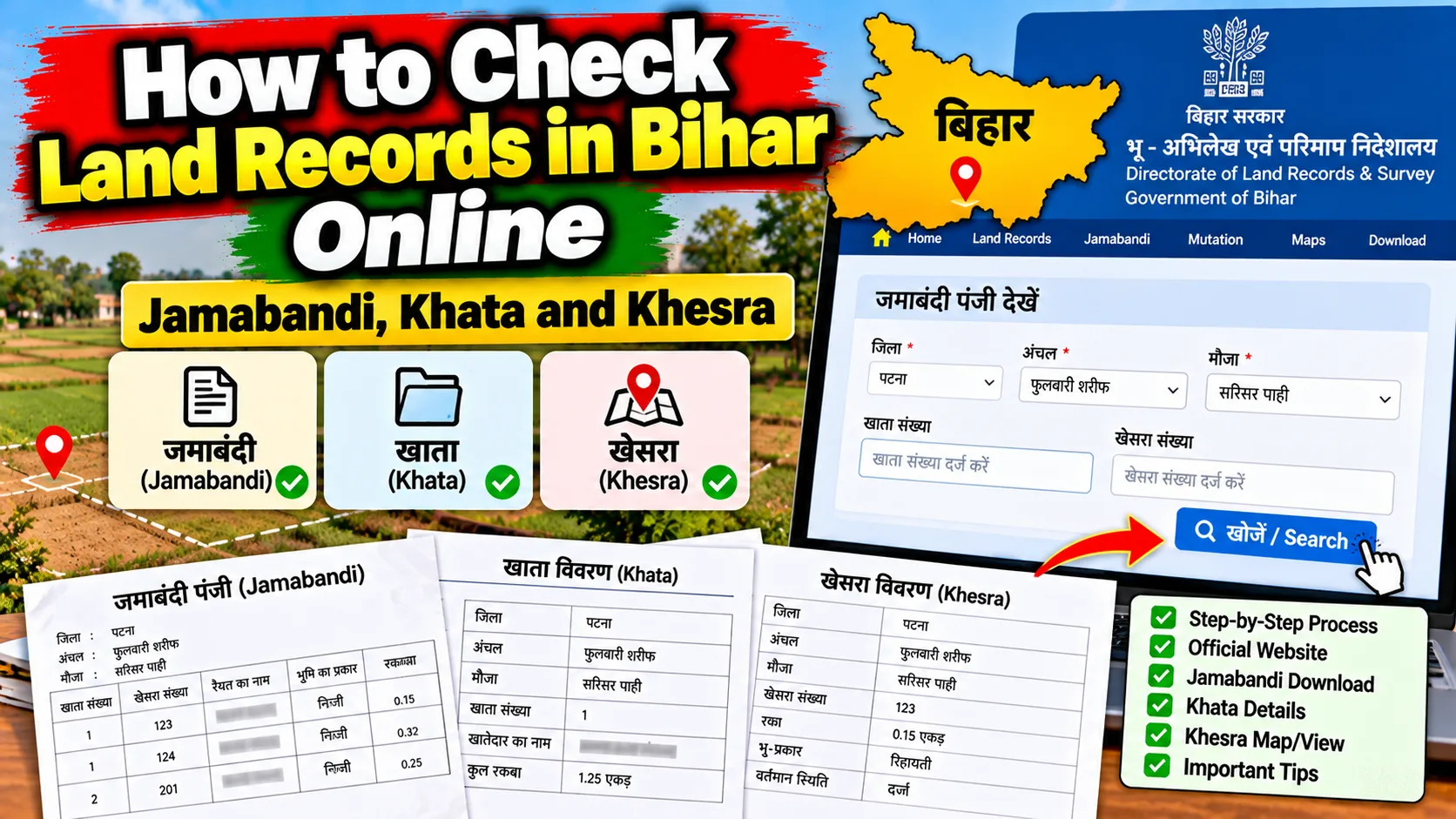
Registration does not automatically change the revenue records. Dakhil-kharij is the process that does. See how to check Bihar land records online to see what your records show now.
When you need it
- After buying land with a registered sale deed. See the property registration process.
- After a gift deed.
- After inheritance, when a landowner dies and the legal heirs want the records in their names.
- After a partition among family members.
- After a court order or settlement that changes ownership.
Why it matters
- You cannot pay land rent (lagan) in your name and get a receipt without it. See how to pay land rent online.
- Banks and buyers look at the revenue records, and a mismatch can block a loan or a sale.
- Government schemes, compensation for land acquisition and crop-related benefits usually follow the recorded owner.
- Building plan approval often asks for the mutation record. See building plan approval.
- It helps avoid disputes, because a clear record makes your claim stronger.
Documents usually needed
The official portal and your Circle Office tell you the current list. In general, expect to need:
- Registered deed (sale, gift or partition), with the registration details.
- Identity and address proof of the applicant, such as Aadhaar.
- Land details: district, circle, mauza, khata number, khesra (plot) number and area.
- A copy of the existing jamabandi or revenue record.
- Latest land rent (lagan) receipt of the previous owner, if available.
- A self-declaration or affidavit as required.
- For inheritance: death certificate of the owner and a legal heir certificate or family details, and consent or declarations of the other heirs where needed.
- Passport-size photograph and mobile number for notifications.
Third-party guides list a few more items and fees, but they are not official and sometimes contradict each other. Rely on the portal and the Circle Office for the current list and any fee.
How to apply, step by step
Online
Bihar's Department of Revenue and Land Reforms runs the land records portal (known as Bihar Bhumi) and related services, and the department has been moving mutation applications online.
- Open the department's land portal and find the service for mutation (dakhil-kharij).
- Register or log in using your mobile number or email.
- Fill in the form with the details of the buyer or heir, the seller or previous owner, and the land (district, circle, mauza, khata, khesra, area).
- Upload the documents as scanned files.
- Pay the fee if the portal asks for one, and note the application number.
- Wait for the Circle Officer's process. The office checks the documents and the existing records, may issue a notice so that objections can be raised, and may verify the land.
- Check the status on the portal using your application number.
- Get the order. If the application is accepted, your name is entered in the revenue records. Download the order and the updated record, and keep copies.
Offline
You can also go to the Anchal (Circle) Office with the application and documents. Ask for an acknowledgement with a number and a date, and check later with the office or on the portal.
How long it takes
A report from Patna Press dated 13 May 2026 said that the state's revenue department had told officers that undisputed mutation cases should be disposed of within 35 days and disputed cases within 75 days, and that cases pending beyond 120 days should be cleared quickly. These are time limits stated in an official order as reported by a news outlet, and the real time in your circle may differ. Ask the Circle Office for the current rule, and keep your acknowledgement so you can follow up if the file is delayed.
If there is an objection or dispute
When the Circle Officer gives notice, anyone with an interest in the land can object. If someone does:
- The case may become a disputed one and take longer.
- You may be asked to appear and show your documents.
- The Circle Officer decides after hearing the parties.
Mutation decides who is recorded for revenue purposes. It does not settle the ownership. A dispute about title is for a civil court. Keep this in mind both when you buy land and when someone objects to your application.
If the application is rejected
- Read the reasons in the order. They may be minor, such as a mismatch in the khata number, or serious, such as a title doubt.
- Correct and re-apply if the reason is a mistake or a missing paper.
- Appeal to the higher revenue authority within the time given in the order and as the law allows. Ask the Circle Office or a land lawyer for the right forum and the time limit.
Common problems and how to avoid them
- Mismatch in names, spellings or numbers between the deed and the records. Check them before you buy, and correct the records if needed.
- The seller is not the recorded owner, or other heirs have a share. Check the jamabandi before you buy. See documents to check before buying property.
- Area differences between the deed and the records.
- Not applying promptly. The longer you wait, the more complicated it gets, especially if the seller or the heirs change. Apply as soon as the deed is registered.
- Using an agent who asks for extra money. Use the official portal and keep receipts. There should be no unofficial payments.
- Not keeping the final order. You will need it for lagan, loans and sale.
After mutation
- Check the updated record on the land portal.
- Pay the land rent in your name and download the receipt.
- Keep the mutation order with your sale deed, your lagan receipt and your jamabandi extract.
- Use these for a loan, a building plan or a later sale.
Frequently asked questions
Is dakhil-kharij compulsory after buying land?
The registered deed transfers ownership. But without mutation the revenue records show the old owner, which causes practical and legal problems. Treat it as essential.
Does mutation prove ownership?
No. It records who is in possession and pays land rent for revenue purposes. Ownership rests on the title documents and, in a dispute, on a court.
Can I apply from outside Bihar?
If the portal allows online applications and you can upload your documents, yes. You may need a representative for any hearing. Check with the Circle Office.
What does it cost?
Fees, if any, are set by the department and may change. Confirm on the portal. Third-party websites quote different figures, so do not rely on them.
Portals, forms, fees and timelines change. The time limits above are as reported in the news on 13 May 2026 and may have been revised. This guide is general information, not legal advice. Confirm the current process with the Circle Office or a land lawyer.