PMAY-Urban 2.0 Interest Subsidy: Who Qualifies and How to Apply
A clear guide to the PMAY-Urban 2.0 home loan interest subsidy: income limits, loan and house value caps, how much subsidy you can get and how to apply on the portal.
If you are an urban first-time home buyer with a modest income, a government scheme can pay part of your home loan interest. The scheme is the Pradhan Mantri Awas Yojana – Urban 2.0 (PMAY-U 2.0), and its home loan benefit is called the Interest Subsidy Scheme (ISS).
This guide sets out who is eligible, how much help you can get, and the steps to apply, based on the scheme details published on the official PMAY portal. Scheme rules can be revised, so confirm each point on the portal before you apply.
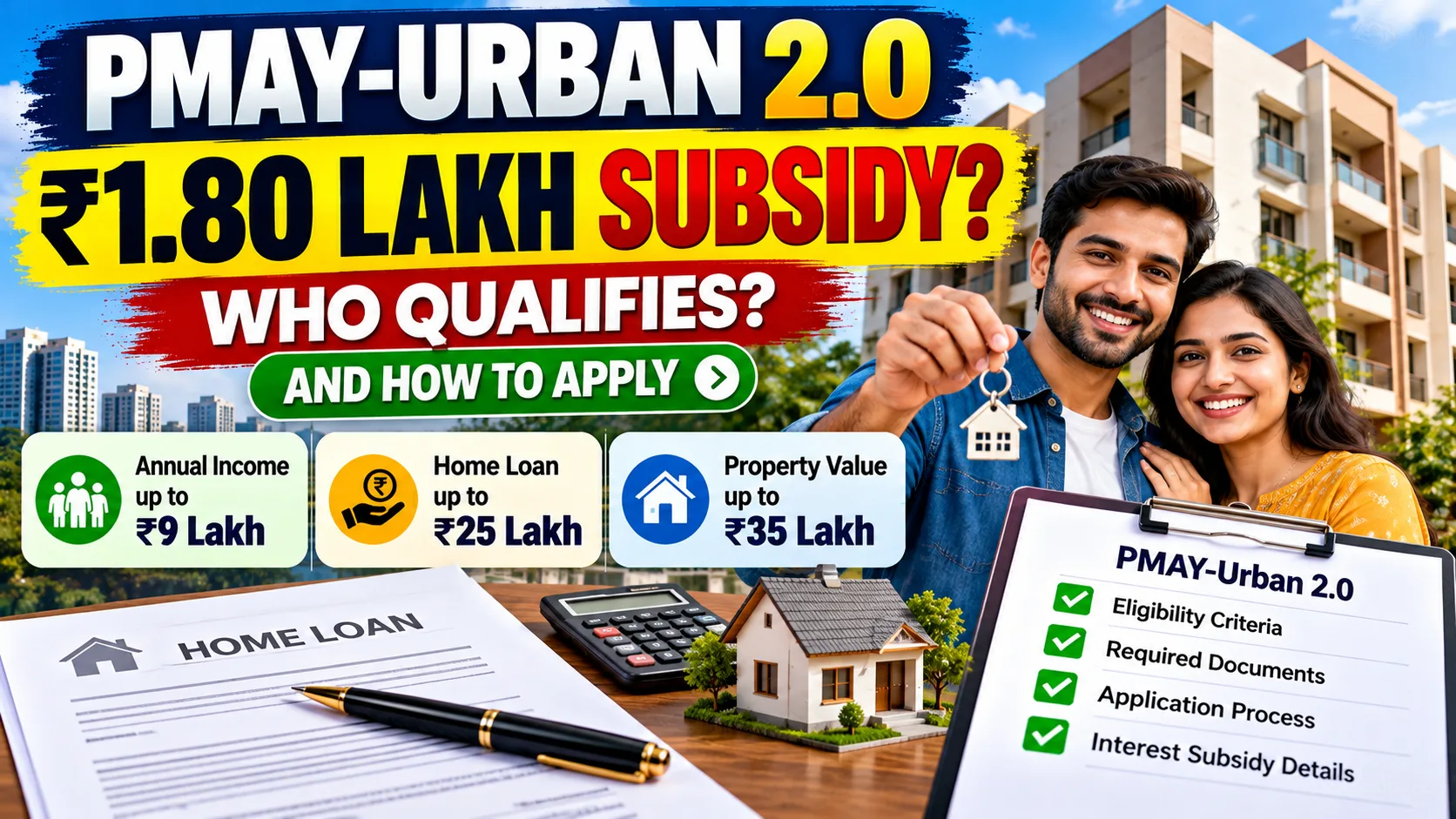
In short: If your annual household income is up to ₹9 lakh and you take a home loan of up to ₹25 lakh for a house worth up to ₹35 lakh, the government can give an interest subsidy of up to ₹1.80 lakh, credited to your loan account. You apply through the PMAY portal.
Who is eligible
The scheme is for urban households in three income groups, based on annual household income:
| Category | Annual household income |
|---|---|
| Economically Weaker Section (EWS) | Up to ₹3 lakh |
| Lower Income Group (LIG) | ₹3 lakh to ₹6 lakh |
| Middle Income Group (MIG) | ₹6 lakh to ₹9 lakh |
Other conditions in the scheme guidelines include the following:
- The home loan must have been sanctioned and disbursed on or after 1 September 2024.
- The loan is for buying, re-purchasing or constructing a house.
- The house must be in an urban area covered by the scheme, and its carpet area should be up to 120 sq m.
- The family, meaning the husband, wife and unmarried children, should not already own a pucca house in India. Read the exact definition in the current guidelines.
- You submit a self-certificate or affidavit as proof of income.
How much help you get
For households with an income up to ₹9 lakh, the official ISS page lists these terms:
- Loan amount: up to ₹25 lakh qualifies.
- House value: up to ₹35 lakh.
- Subsidy rate: 4% interest subsidy on the first ₹8 lakh of the loan, for a loan tenure of up to 12 years.
- Maximum subsidy: up to ₹1.80 lakh is released, with a cap of ₹1.50 lakh on its net present value at an 8.5% discount rate.
In practice, the subsidy does not lower the interest rate your bank charges. It reduces what you owe. The Primary Lending Institution (the bank or housing finance company) credits the subsidy to your loan account, which lowers the principal. This means you pay less interest in later years.
How the subsidy is paid
The subsidy is paid in five equal yearly instalments by direct benefit transfer through the lender, as described on the portal. The lender can also credit the amount upfront by deducting it from your principal, provided the loan is active and more than half of the principal is still outstanding when the subsidy is released.
You will need to geo-tag the house. For a house you bought that is already complete, this is done after the first instalment. For a house under construction, it is needed before each instalment, and the completed house must be geo-tagged before the fourth instalment.
A simple example
Take a household with an annual income of ₹7.5 lakh (the MIG category) that buys a ₹32 lakh flat with a carpet area of 60 sq m and takes a ₹24 lakh loan for 15 years.
- The flat is under ₹35 lakh and the loan under ₹25 lakh, so both caps are met.
- The income is under ₹9 lakh, so the household is in the MIG group.
- The 4% subsidy applies to the first ₹8 lakh of the loan, within the scheme's maximum subsidy limit. The rest of the loan, ₹16 lakh, gets no subsidy.
- The subsidy is credited to the loan account through the lender, lowering the amount owed.
Your own figure will depend on the scheme's calculation and your lender. Ask the lender to show you in writing how much subsidy it expects to receive on your loan and when.
Who cannot claim
The portal lists several exclusions. The main ones are:
- A loan above ₹25 lakh or a house above ₹35 lakh does not qualify.
- The subsidy can be claimed only once per property. If the previous owner of a resale house has already claimed it, you cannot.
- Family members with loans on the same property are treated as one family for income and benefit purposes.
- Borrowers who move their loan to another lender (a balance transfer) cannot claim the subsidy again, even if they did not claim it from the first lender.
How to apply
- Check the eligibility rules on the official PMAY portal and decide which income category you belong to.
- Apply for a home loan with a lender that takes part in the scheme. Public sector banks, many private banks and housing finance companies are Primary Lending Institutions, but confirm that yours is one.
- Register your demand on the unified web portal (pmaymis.gov.in). Your application is then forwarded to your lender.
- Keep documents ready: identity and address proof, PAN or Aadhaar, income self-certificate or affidavit, property papers and the loan sanction letter. Many lenders also collect a declaration that your family does not own a pucca house.
- Track the status on the portal and with your lender, and complete the geo-tagging when asked.
Tips to avoid problems
- Tell the lender at the start that you want to claim the PMAY subsidy, so that the loan is structured accordingly.
- Check the property before you buy. A flat with title problems or without approvals can derail both the loan and the subsidy. Use our documents checklist and verify the project on RERA. See how to check a project.
- Stay within the caps. If the house is slightly above ₹35 lakh, the subsidy does not apply. Compare your options before you fix the purchase.
- Be truthful in the self-certificate. A false declaration can lead to the subsidy being cancelled and recovered.
- Keep every acknowledgement and the application number.
How it fits with your other costs
The subsidy reduces your interest burden, not your down payment or taxes. You still need to pay the margin money, stamp duty, registration and other charges. See the hidden costs of buying a flat. Whether you can also claim income tax deductions on the loan is a separate question, covered in our guide to home loan tax benefits.
To see whether your income and loan fit the limits, start with how banks decide your home loan eligibility.
Frequently asked questions
Is PMAY-Urban 2.0 for rural areas?
No. It covers urban areas as defined in the scheme. Rural housing is handled under a separate scheme for rural areas.
Can I use the subsidy to buy a resale house?
The scheme covers purchase and re-purchase, but only if the subsidy has not already been claimed on that property and you meet the other conditions. Check this with your lender before you sign.
Do I have to be a first-time buyer?
The guidelines require that the family does not already own a pucca house in India. Read the current definition of "family" and "pucca house" on the portal, and ask your lender how it checks this.
What if my income is above ₹9 lakh a year?
The interest subsidy is not available to households above the MIG limit. You may still be able to claim income tax deductions on your home loan.
Scheme terms, cut-off dates and income limits can change. This guide reflects the details published on the official PMAY portal when it was written. Always confirm the current rules on pmaymis.gov.in and with your lender before you apply.